Showing posts with label comprehension. Show all posts

Sunday, 4 January 2015

Comprehension - Part #5. Questioning

Questioning involves students asking and answering questions about a text. I'm not talking about basic questions like "what colour was the house?". I'm talking about deeper questions like "I wonder why the character....".

To get students familiar with asking the deep questions, introduce the thinking stem "I wonder". This automatically lends itself to deeper questioning as it requires students to come up with a question where the answer is not immediately obvious.

When introducing this strategy with my year one class, I used the wordless text, Window by Jeannie Baker. Any wordless text would do, but I love Jeannie Baker books as there is always so much going on in every picture.


As we looked through each page, I gave students a post-it note and asked them to write down their "I wonder..." questions. I got responses such as;

"I wonder why the birds are flying away from the park"

"I wonder why the boy is playing inside and not outside"

We then shared our questions with the class, and used these questions to start a discussion and hopefully find an answer to them. For the question about the birds, one student suggested that the birds were flying away because trees were being chopped down to make room for the houses. Pretty awesome for a year 1 class right?

By providing students with a thinking stem, I helped scaffold their learning, as opposed to just telling them to come up with a question about the text.

Once we had this down, we moved on to other thinking stems that promote deep questions, such as

What would happen if?

Why would...

These stems work best with a rich text, simply use the same procedure as introducing the "I wonder..." questions.

After the introductory lesson/s implement deep questioning as part of your guided reading groups. These questions also link really well with any scientific investigation!

You can even set up an "I wonder..." wall in the classroom that can be used throughout the year.

I have a bunch of Comprehension resources in my store that are very useful for implementing the strategies in your classroom :)

Next up, Summarising!

Sunday, 26 October 2014

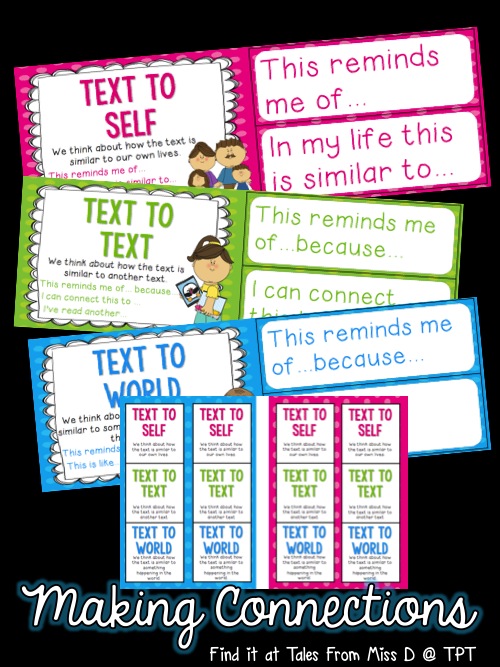
Comprehension - Part #4. Making Connections

Making Connections is a great strategy to get students thinking about the text and how it is similar to themselves, another text or the world in which they live in. Making connections helps develop a deeper understanding of the text and the characters.

The easiest one to start with is Text-To-Self Connections.

To introduce this, I would pick a basic book that is about a situation that pretty much anyone can relate to. For the younger grades, any Charlie & Lola book is perfect. Before reading, tell students that you want them to listen to find a part of the book that is similar to their life. Read through the book and then have students talk with a partner about how they are similar to book/character.

Put up the prompt "This reminds me of..." on the board and have students use this to guide their answer for reporting back to the class.

In terms of bookwork, have students draw a picture and then write a sentence/paragraph about their connection. You can use the following sentence starters;

* This reminds me of...
* The character is like me because...
* I remember when...

Once students are comfortable with Text-To-Self connections, move onto Text-To-Text. Make the connection (ha!) between what they have just done and what they will be doing now (listening to connect). Good texts to use for this;

* The Gruffao and The Gruffalo's Child
* The Three Little Pigs and The True Story of the Three Little Pigs
*  The Stinky Cheeseman & Other Fairly Stupid Tales and any fairytale covered in the book
* Little Red Riding Hood and The Wolf's Story

Once again have students discuss and then write. This time use the sentence starters;

* The character _______ reminds me of ____________ in ________ because...
* The text ____________ reminds me of ___________ because...
* This story is like _______ because...

Teaching Text-To-Text connections provides a great starting block for comparing texts.

The last connection to teach is Text-To-World. Any text that is about a global issue would be fine. One of my favourites is George Saves the World by Lunchtime. This text is also great for reminding students about recycling and disposing of rubbish thoughtfully :D

Use these sentence starters to guide student responses;

* This reminds me of _________ because...
* This is like when....
* Something similar happened....

Once you have introduced these strategies, you can then use them as reading response activities. A great way to practice writing and encourage deeper thinking about what students have been reading!

I have a pack of posters and thinking stems in my TPT store that would be a perfect companion for teaching this strategy;
http://www.teacherspayteachers.com/Product/Super-Six-Comprehension-Strategies-Making-Connections-1432954

Next up: Questioning!

Saturday, 11 October 2014

Back to School + FREEBIE

I've kind of neglected this blog over the past week or so. Whoops!

The school holidays are over now. I didn't spend that much time on the computer, hence the lack of posting. My goal for the holidays was to spend at least an hour each day doing something active outdoors. The area that I live in has quite a few parks and walking/bike tracks. So my boyfriend and I went for lots of walks, runs and scooter sessions. Our building has a pool too, so on the hot days we went swimming (i.e I learned to swim). It was nice being able to do things outdoors during the week. On weekends, it's always a bit hectic with all the bike riders and dog walkers.

Aside from doing outdoorsy things, I went shopping and bought an iPhone. I got the 5c in blue. I love it! Now I finally get to hear the magical Ka-Ching that all the teachers talk about on the forums :D

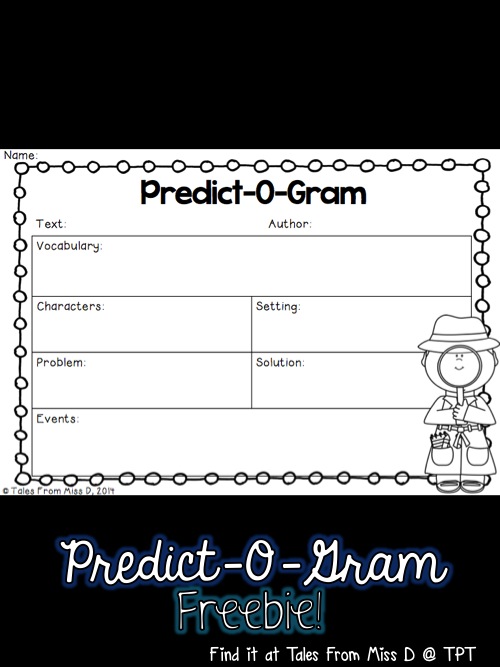
School is back for the final term of 2014. I am still working with the same classes and focusing on reading groups. This week, we started with new texts. One activity that we have been working with is a Predict-O-Gram. Click on the picture to get your own FREE copy on TPT! (celebrating 300 products freebie).

http://www.teacherspayteachers.com/Product/Predict-O-Gram-1492482
Before reading, we fill out the boxes. Students make predictions about the vocab, characters, setting, problem, events and resolution. After reading, we look back at the predictions and confirm or reject as well as discuss the similarities and differences. Great activity to get students thinking about the text!

Will try and find some time this week to add to my Comprehension series.

Enjoy your weekend!

Wednesday, 24 September 2014

Comprehension - Part #3. Predicting.

Predicting is also an easy strategy to teach. Chances are, you are already doing it with your students, but the aim of this is to;

a) get your students to look closely at the clues in the text 
and 
b) get them to do it automatically, rather than have the teacher prompting all the time

To start off, define what predicting means. Explain that we predict before, during and after reading. Talk about what students can use to make a prediction; cover, titles, illustrations, blurb and text.

Pick a text and have students make a prediction. Give them the sentence starter "I predict". When they tell you their prediction, ask them why they think that. What clues from the text did they use? The sentence starter now becomes "I predict.....because.....".

You can use the above discussion for during reading predictions too.

As for after reading, the discussion turns to talking about what would happen if the author were to write a sequel. Students will use the events from the story to make this prediction. The sentence starter would be "I predict that......would happen next because.....". This can then turn into a writing task if you wish.

It is also important to confirm or reject predictions. That is, talking about whether they were right or wrong. Confirm or reject is just a more technical and nicer way of putting it. At this point, emphasise that it's totally okay if their predictions were rejected. Build up esteem by talking about how well they used the clues from the text :)

A neat way to set up this activity is to use three columns. My Prediction, What Happened and Confirm/Reject. The first two columns are pretty self explanatory, the confirm/reject can be completed with either a tick or a cross, or a C or a R.

If you want students to write about their predictions, here are some ideas;
1) Sentence starter "I predict" or "I predict....because..." Students can draw a picture to support their writing
2) Two columns. My Prediction and Clues From The Text
3) Have students predict what the characters will do, what the problem will be and how they will solve the problem.

My all time favourite activity is to stop reading just before the big ending. Have students write what they think will happen and draw a picture. Then read the ending and compare. It's one activity that the students absolutely love and it's pretty interesting seeing what they come out with.

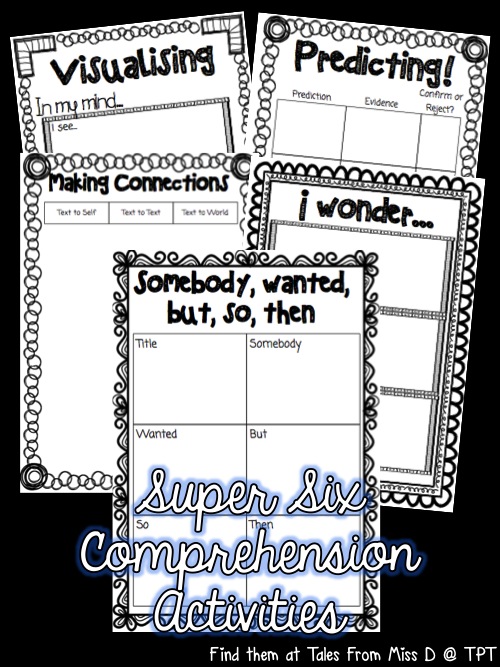
That's pretty much it for predicting. If you are looking for some graphic organisers they can be found in my Super Six Activity Pack;

http://www.teacherspayteachers.com/Product/Super-Six-Comprehension-Strategies-Activity-Pack-1259213

Next up in the series; Making Connections!

Saturday, 20 September 2014

Five for Friday!

Linking up with Doodle Bugs Teaching for Five For Friday!


School - Friday was the last day of Term 3. I am now on holidays for 2 weeks! :D My plans? scootering, swimming, days out and resource making. I am keen to get back out on the scooter as it's been ages since we've been able to do it. Next term I officially start my contract! woo hoo!

TV - We got the TV we wanted! Now our lounge room has a brand new, 50', 3D, smart TV. It's awesome. I love it, especially watching movies in 3D. We watched the Lego Movie and it looked pretty cool especially when there was lots of movement. Of course watching that movie got the Everything is Awesome song stuck in my head, which lead to random outbursts of "everything is awesome!" over the past few days.


There are also other neat features with the TV, like the ability to go online, download apps or even tweet from the TV.

Resources - I've been pretty productive with my TPT store lately. I've made a few new things as well as made different designs for some of my most popular products. This morning I revamped my 2D Shapes pack because I felt like it should be more colourful. It wasn't ugly or anything, I just decided that rainbow paper would make it even better! (did I ever mention I was a perfectionist?). Click on the picture to see it in my store :)

http://www.teacherspayteachers.com/Product/2D-Shapes-Posters-and-Games-1291936

Text Type and Purpose - This week one of the focus points of my reading groups was talking about the text type and author's purpose. I introduced the three types; Informative, Imaginative and Persuasive. We then talked about how we know which type it is, e.g. whether it was giving us facts, about a made up person or telling us why something is good. These three types then link to the author's purpose; inform, entertain or persuade. To help with these concepts I created a few posters.

http://www.teacherspayteachers.com/Product/Text-Type-and-Purpose-Posters-1453608

Comprehension - In my reading groups we are also using the Super Six Comprehension strategies. We do a lot of discussion, which is great but then I want the students to be writing/recording ideas so the classroom teacher has a way to see what we have been doing. So to cater for this, I am using my Super Six Journal Prompts!

http://www.teacherspayteachers.com/Product/Super-Six-Comprehension-Strategies-Journal-Prompts-1432913

These are great because I simply need to print off one or two copies of a page, cut out the strips and then the students glue the prompt at the top of their page. They then complete the activity. So now when the teacher looks back in their book they will be able to easily see what the activity was :)

That wraps up my Five for Friday. Will work on the next part of my Comprehension series sometime in the first week of the holidays.

Enjoy your weekend!

Saturday, 13 September 2014

Comprehension - Part #2. Visualising.

It's time for part 2 of my comprehension series!

Visualising
This is the easiest strategy to work on, so it's the best one to start with.

Introduce the strategy using a poster/PowerPoint/movie e.t.c. Find a text that has a description of a character, object or place. Texts that are good for this are; The Twits by Rhald Dahl, The Gruffalo by Julia Donaldson, The Gruffalo's Child by Julia Donaldson and Inside Mary Elizabeth's House by Pamela Allen.

Read with an emphasis on key features that you want the children to pick up on (i.e change your tone of voice). This will signal to students that they should pay attention to this feature for their visualisation. Of course, once students are more familiar with this strategy you will not need to alter your tone.

Depending on what age group you have, you can get students to label their drawing using words and phrases from the text that they used to create their visualisation. These labels can then be used to write sentences. Don't you just love it when everything links together? At the end, show students the picture in the book and have them make comparisons between their drawing, the book and their classmates' drawings.

Music is the perfect text for visualising scenery/setting. YouTube has lots of great clips for rainforest, oceans, cities and whatever else you want. Start off by playing the music, have students close their eyes and visualise the place. After the piece has finished, brainstorm a list of this that they heard and talk about what kind of place it would be. Students can either draw or create a mixed media artwork to represent their visualisation.

Another fun visualising activity is to read sections of a text and have students draw what is happening. You could even extend the activity and have each student visualise a different section, then put all the pictures together at the end to create a comic strip of the text.

Create a wall that teaches in your classroom by hanging up student work samples under posters/anchor charts. The students will love it, it will make your room look bright and colourful and it provides a visual reminder for student learning! 

If you are looking to do the Super Six in your classroom, I have a range of posters in my store. Click here to check out the Comprehension category.


I'm pretty proud of these posters. The backgrounds and borders were made by myself :D

Next strategy; Predicting!

Saturday, 6 September 2014

Comprehension - Part #1

One of my favourite things to teach on a relief day is something related to comprehension. When I say comprehension I'm not talking about those 'read a passage and answer some basic questions' activities, I'm talking about metacognitive strategies.

One of the biggest impacts on my teaching was the 2 year long professional development program that I participated in while on year 1. The things I learned in that program have stuck with me and have changed the way I teach. I noticed a positive impact in my students growth, so of course I am passionate about it and keep on finding new ways to implement it in my teaching. This is reflected in my TPT store as quite a few of my products relate to comprehension.

Over the next few posts I will be sharing my knowledge and experiences as well as some teaching ideas :)

The Super Six Comprehension Strategies
Obviously this is the starting point as the rest of the ideas all relate back to the strategies. A while ago, I wrote a post about how I introduced them to my year 1 class. You can read all about that over here.

I recently revamped the strategies into 'Super Powers'. Kids love Super Heroes, so I thought that it would be cool to have a 'We can be reading superheroes by using our Super Six Comprehension Powers' theme. I think it works pretty well as by using these "super powers" they are able to have a deeper understanding of what they are reading :)

http://www.teacherspayteachers.com/Product/Super-Six-Comprehension-Strategies-Super-Powers-1381461

If I were on class, I'd have a wall with each poster hanging up and student work on display underneath each poster to form a wall that teaches. The work would rotate regularly to keep it fresh and be relevant to the topic that we are covering. Sounds like a lot of work, but it's really not that hard. The pride the students have when their work is up makes it worth it :)

My role is different this year, so what I do with these strategies is sort of the same but different. I'll use all the strategies with each text that we read, but I'll have a focus lesson on one of the strategies. In the lesson we define what the strategy is, what we do with it and how it helps us. Why do I do a focus lesson? because I think it's always beneficial to brush up on these skills! As a classroom teacher, I loved when a relief teacher would do a lesson that recapped key skills because there are always some kids that could do with that extra practice.

Examples of focus lessons for each strategy;
Visualising - read a section of text and have students draw what they think the character/scene/object looks like. Students label their picture and then write sentences to describe. By getting students to label you can what clues they used to form their visualisation (i.e it the text mentioned that the monster has red, bloodshot eyes and the student uses that exact label you can see that they have been paying close attention).

Making Connections - read the text and students use a sentence starter to write and draw their connections.

Predicting/Inferring - Have students orally tell or write down their predictions throughout the reading of the text. Get them to back up their predictions with evidence from the text.

Questioning - Have students come up with "I wonder..." statements and then have other students answer the questions. Great way to encourage accountable talk!

Summarising - Somebody, Wanted, But, So, Then. I love this strategy for summarising. It's a great way to introduce it and a starting block for moving onto more detailed summaries. Have the younger grades draw a picture for each, the older grades can use it as a writing prompt. e.g ______ wanted to ____ but _______, so ________ and then ________.

Monitoring - Fix up strategies. This is probably the hardest one to do as a relief teacher, but if you're on class start off by introducing each strategy then slowly start integrating them into your reading groups. The more practice, the better :)

If you're on class, you'll notice your students using these automatically, once they have got the hang of them.

To help develop these strategies, I made two resources. I am finding this first resource very useful in my new role. As a relief teacher, I'm never quite sure if the class teacher would mind if I let students use their books, so naturally using paper is the easier and confrontation free option. Of course, if you're on class this is also very useful in developing the strategies with your students.

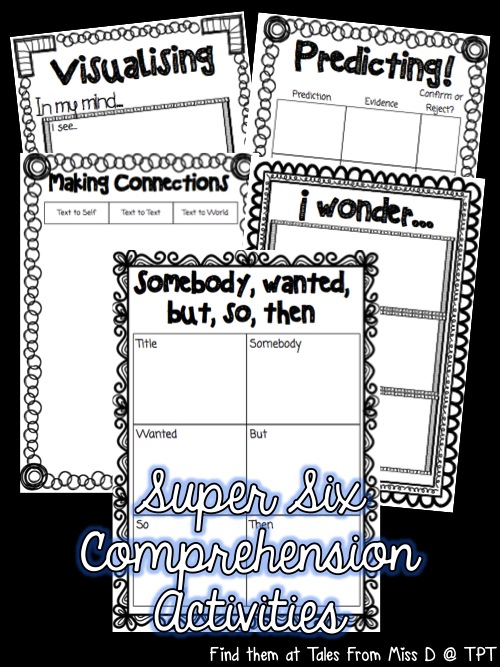
http://www.teacherspayteachers.com/Product/Super-Six-Comprehension-Strategies-Activity-Pack-1259213


This pack is full of graphic organisers for each strategy. There are variations of each activity to cater for different grades and abilities. Each page has a cute border and heading that can be decorated at the end (because students always want to colour in and make it pretty).

Not only do these serve as an activity, they can be used a part of a comprehension journal, a portfolio, an assessment or even as part of your wall that teaches.

Another thing that can be done with the strategies is a Comprehension Journal. I created a collection of journal prompts that can easily be printed and stuck in student books. This will benefit students who struggle to copy off the board as well as combat those "Miss, I only copied the question" moments. Each prompt has a reminder of the strategy at the top for quick reference.

http://www.teacherspayteachers.com/Product/Super-Six-Comprehension-Strategies-Journal-Prompts-1432913

This is also a big help for teachers who face photocopying restrictions. Only a few copies need to be printed as opposed to a full class set :)

Visuals are a very important in student learning. I love walking into rooms full of anchor charts and walls that teach. However sometimes it's not practical to have students roaming around the room so this is where bookmarks and a quick reference page come in handy!

http://www.teacherspayteachers.com/Product/Super-Six-Comprehension-Strategies-Bookmarks-Quick-Reference-Page-1361614

Simply print and laminate to have a colourful bookmark that students can easily refer to at their desks. The quick reference page can be stuck in their workbooks.

An important part of using these strategies is incorporating them into classroom discussion! By modelling these to your students, you will be encouraging them to use the strategies in their own conversations. Here is a fun way to get it started; Question Sticks!

http://www.teacherspayteachers.com/Product/Comprehension-Questions-Comprehension-Sticks-1428700

These require little preparation! Just print, laminate and attach to a paddle pop stick. Alternatively you can just print, laminate and put in a jar. Make asking and answering questions a little bit more exciting by having students pick a question from a jar and have a class discussion. Think about it, what's more fun? sitting there being asked questions by the same person? or hearing from a variety of people? You'll also find that once students become familiar with these questions, they will start asking them without the prompts. Remember, modelling is the key!

Comprehension can be a lot of fun, integrate it as much as possible. The only time it should be a stand alone lesson is when you are introducing the strategies! Once your students have got it, they should become a natural part of your lessons.

The next couple of posts on this topic will be talking about specific strategies. Stay tuned!


Friday, 5 September 2014

Casual Teaching and a WOW Text!

I changed my blog layout again, I decided that I wanted something a bit more simple and clean looking. I'm quite happy with the way it turned out. Though that never lasts long and in a week I'll want another layout :P

This week I worked 2 days. I didn't expect much work as the school production was. It was good timing, as I felt pretty sick on Wednesday and Thursday. There's no way I would have managed to drag myself into work anyway.

On Monday, I had year 5. I was excited about this because that meant I could finally use a book I recently bought; Journey by Aaron Becker.

This was one of those WOW! Books; you know when you pick it up for the first time and all these teaching points just jump out at you and you're just like "wow!"? (Please tell me I'm not the only book nerd out there).

If you've never heard of it before, it's a story told entirely by the pictures. So straight away it lends itself to Inferences. The illustrations are beautiful with lots of fine details and a clever use of colour. Each page can be used as a stimulus for deep discussion.

To kick of the lesson, I revised the skill of Making Inferences. What is it? Why do we do it? 

Then we viewed the book trailer. Which you can view here. That was a really great way to build excitement about the text. If only every text could have a trailer!

Students made an inference on what they thought would happen in the book and they had to back up their inference with the clues that they used.

Then we went through the text and discussed what they thought was happening on each page. At key points we stopped and students wrote down their during reading inferences. Once again it was important that they justified their response with what text clues they used. This was a way for them to show me their thinking and ability to read the visuals.

The ending of the story is awesome. Basically another lonely child rescues the main character and they become friends. People who were paying close attention to the first page would have noticed that the boy is also lonely at the start. It somewhat blends in so you don't notice it, but it's there.

The students loved this text. There is a part 2 called Quest. I am looking into getting that too. I would recommend this text to anyone. It can be used across all grades and for a variety of purposes. A must have for any casual/sub/relief teacher!

This class participates in Genius Hour. I have seen this going on in a few classrooms and I am quite interested by it. The class was supposed to go to the computer lab to work on it, but the lab was taken by another class due to room changes. Never mind, we made do inside the classroom with the iPads and few computers available. I sat with a group of ESL students and helped them research their questions about pirates. I learned a few things while helping them. Did you know that only one pirate ever buried their treasure? :) I can't wait to get my own class again to try this out as a regular thing.

For the past few days while I've been at home sick, I have worked on some more products for my TPT store. Here are three of my latest products. Click on the pictures to view them on TPT;

Writing Task Cards - List Making & Sentences

http://www.teacherspayteachers.com/Product/Writing-Task-Cards-1428969
http://www.teacherspayteachers.com/Product/Writing-Task-Cards-Writing-Sentences-1430442

 These are great to use as part of your literacy groups or a 'work on writing' center. Each pack includes 52 cards as well as an instruction page for students.

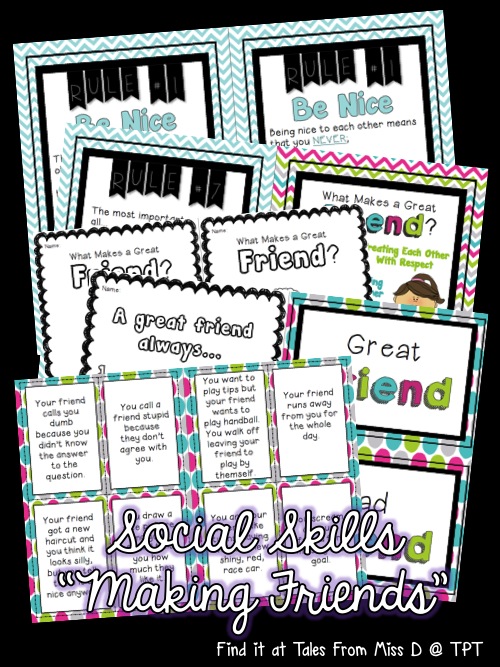
Social Skills - Making Friends

http://www.teacherspayteachers.com/Product/Social-Skills-Making-Friends-1430319

This pack aims to teach students about making and keeping friends. I think this is an important skill for some students as they lack the knowledge of what makes a good friend. I created a text that explains 7 "rules" of being a great friend with an explanation of each. There is a poster, worksheets and a sorting activity. I love using these social skills packs on my casual days as it provides a simple 30 minute lesson on key skills that sometimes students need reminding of. Also helps with the smooth running of a classroom :) If you are interested you can check out my Social Skills collection here.

Lastly, I was super excited to FINALLY see myself on the front page of TPT. I just had to screenshot it! I've always wondered if I have been on there and well now I know :P


That's all from me, enjoy your weekend!

Saturday, 9 August 2014

A Week on Year 4

This week I was lucky enough to have one class for the entire week! I had a lot of fun. It's nice when you can plan a series of lessons that connect, rather than just turn up and do random, one off lessons.

So this post will be about my favourite lessons of the week, because if I write about everything, this will turn into a TLDR post.

For Literacy, I focused on The Gizmo by Paul Jennings.

I love his stories, I remember reading them as a kid and would spend hours reading them in one go. The Gizmo is a great story to do with the older grades as the story is interesting and has themes the students can relate to. If you haven't read this book before, it's about a boy called Stephen who is pressured into stealing by the school Bully, Floggit. Stephen feels guilty about stealing so he tries to make it right by returning what he stole. However he can't, so he tries to rid himself of the item in different ways. Along the way he faces a few entertaining mishaps and by the end of the story he has learned his lesson.

I had only read the first chapter, when the students started to ask and answer their own questions about the story (by themselves! I didn't even have to ask them to!). The main question; "Why would Stephen hang out with this Floggit guy when he is such a jerk?". So that started a big discussion on how sometimes people hang out with people they don't necessarily like because they don't want to be an outcast or seen as a loser.

Throughout the week we did a few activities around the book such as; coming up with excuses to tell Floggit to avoid stealing the Gizmo and character profiles. The character profile activity produced some great responses. I let the students design it however they wanted. So some of them did it as a wanted poster, some as a profile and one student drew a picture of Stephen and wrote paragraphs about his personality around the picture.

We finished the book on Thursday and I told the class that if they liked the story they could go to the library and check out other books by Paul Jennings. I also mentioned how he wrote a few other books about The Gizmo, so they begged me to bring them in for Friday.

On Friday I read The Gizmo Again.


Which, automatically lent itself to Text to Text Connections. Similar theme as the original; nice guy gets influenced by the bad guy to do the wrong thing and so he learns his lesson to not listen to the bad guy.

We also did some Reciprocal Teaching. I got to use my Reciprocal Teaching Pack (don't you just love shameless promotion?).


The text we used was Possum Magic by Mem Fox. To start off I went through each of the roles, the class was already familiar with this strategy, so it was a quick recap. Then as we read the text, students practiced using the roles. The text was good for the clarifying strategy, as it involved a lot of Australian terms and since some students were from different cultural backgrounds they didn't know what some of the things were. The internet was used to help with the visuals.

Another great Literacy lesson was about the book, A Little Election by Danny Katz.

After we discussed the story, I gave the students the task;
Imagine you want to be the 'Prime Minister of (insert school name here)'. What policies would you introduce and why? Develop a campaign to convince your teacher and peers to vote for you.

Students were allowed to work in groups or individually. They were allowed to develop their campaign however they wanted. Some students wrote a speech and some designed a poster. They used paper, computers and iPads to present their ideas.

I was pretty impressed, they came up with a lot of good ideas as well as justifying the reasons behind them. Was pleased to see that no one came up with the 'We will just play all day' idea :P

Our Art topic was 3D Illusion Art. Last week, I did the 3D hand activity and they were pretty impressed, so I did some research and found two more activities. On the Monday we did this one;

(Image credit; http://www.frubilledkunst.dk/)

On Tuesday, when I came back (on Monday, I had no idea that I would be back on that class for the rest of the week), a few of them had taken them home and completed them to show me. So, I knew that I had to find another one to do with them on my last day. We did this one;

(Image credit; http://www.teachkidsart.net/)
The thing I love about 3D Illusion Art is that it looks complicated, but it's actually quite simple and the kids just love it! It kind of makes me want to start up some kind of Art Club if I get a job next year...

I really enjoyed my week on the class. I've always seen myself as an Infants Only teacher, but I think I would quite enjoy having a year 4 class. I kind of wish I had put different preferences on my EOI for 2015. The kids kept asking me if I could be their teacher next year, lol. I wish!

Next week, I have work on Monday and then I am back to waiting eagerly by the phone. I seriously think I am the only nutter who is up at 5am each morning so I can be all ready to go if I get a call after 6am :P

In TPT news, I have uploaded a bunch of new products and revamped a few of my older ones. I'll write about them next time.

Enjoy what's left of your weekend :)

Saturday, 26 July 2014

Scooters, teaching and etc!

This week has been busy!

On Sunday my boyfriend and I bought scooters. The area we live in has a lot of outdoor areas, so it seems silly not to have an outdoor activity. Bikes would have been too bulky to store in the apartment and I don't think that I would be that great at it. Scooters seemed like the most practical option. We went to a whole heap of stores to find a scooter that would be appropriate for an adult. We were not having much luck at first, everywhere seemed to stock the Razor scooter, which was way too small. We were about to give up, when we found The Commuter Scooter at Kmart. It's a lot bigger and sturdier than the Razor as it's made for teenagers/adults. I was a bit wobbly at first, but after a while I got the hang of it. It's so much fun and a good work out too. My arms and legs were feeling the burn after the 2hr ride. We did attempt to go riding after work during the week, but I was too tired. I think it will be a weekend/no work day activity :P

On Monday, the technician from the internet company came out to fix the connection. Turns out the people who lived here before us took a cable out of the network cupboard, so that's why it was not connecting. There was also a cable that needed to be swapped in the building's cupboard. So we were not charged a fee as it was not our fault. Win!

On Tuesday, I had a year 3 class. I was originally told that I was on a year 5, so I had come prepared for that, but then it was changed. The teacher left work so I did not have to do any last minute emergency planning. It was a good day, especially because I had a bunch of students from my 2012 class :)

On Wednesday, I had the same year 1 class as I have had previously. It's nice to come back to the same class because you learn their names and get a picture of what their abilities are. Here are some of the lessons that I did with them;

* Reading Response - I love Dr. Seuss books, my all time favourite book is "I Wish That I Had Duck Feet". If you haven't read it before, it's about a boy who wishes for various animal parts because they would benefit him, however along the way he recognises that they would also cause problems for him. In the end he just wants to be himself.


After reading the book, students had to draw a picture of themselves with an animal part that they would like to have. Once the picture was drawn they had to label it and then write about why they wished for it. Students used iPads to look at pictures of animals to help them with their drawings. In the end students shared their response with the class.

* Time - Years ago, I bought one of those educational clocks. It's been very useful for casual teaching and even in my own class. I brought that in with me and we did o'clock times. After I did several examples on the clock, I picked students to come up and make some times for the class to read. Then we played a whole class matching game, matching pictures to the correct time label. Then they worked independently on a worksheet and then we finished off with a game of bingo.

*  Comprehension, Summarising - Elmer books are always popular with students, so I brought in Elmer and Wilbur. The version I have comes with a CD reading off it, complete with sound effects. After hearing the text, students summarised the story by completing a story map. They then used the story map to help them retell the story orally.

During the day I used GoNoodle. I love this site and the kids do too. It's very useful for brain breaks between lessons and the kids love watching the character grow after completing a few activities. The Frozen song was the most popular activity. If it were up to the kids, we would have sung Frozen all day :P

On Thursday, I was on Kindergarten. The teacher left me work. It was tiring, but a good day overall.

On Friday, I was called in to cover classes while teachers went to help prepare for the big school celebration. I ended up on Kindy for 2 hours and then spent the rest of the day making displays. It was a lot of fun. If I wasn't a teacher, I would be a graphics designer. Taking requests and fulfilling them made me feel like I was working as one :) I'm pretty happy with the way things turned out, they looked fabulous! I will make a modified version of the pennant bunting and upload them to TPT at some point.

I have also been working on new resources for myself, which I have added to my TPT store. Here are some of my latest products;

http://www.teacherspayteachers.com/Product/Reading-Response-Activity-Pack-1346392

This activity pack contains 11 activities that can be used with any fictional text. This is pretty useful for me at the moment because I always use fictional texts on my casual days. Some of the activities include; designing a different cover, book review, creating a character, character profile and writing tasks.

http://www.teacherspayteachers.com/Product/Morning-Routine-for-SMART-Notebook-Space-Theme-1341707

I love doing the morning routine on the SMART board. This file includes your typical pages; days of the week, calendar, number of students, weather chart and days at school.

http://www.teacherspayteachers.com/Product/Recount-Writing-Activity-Pack-1336801

This activity pack contains resources to teach recount writing to your students. Alternatively it can be placed in a folder as part of a writing center. Includes a poster explaining what a recount is, an example text and word wall cards.

Check out my TPT store to see the rest of my new resources.

So far I have one day of work next week. I have a year 4 class on Monday. I have almost finished planning my work for the day. I like having the older grades because you can do more independent tasks with them. I am going to be using the iPads as part of one of my literacy lessons. Should be fun :)

Enjoy the rest of your weekend!

Thursday, 26 June 2014

Casual Teaching on Year 1: Rhyming Words, Summarising and 2D Shapes

Today I was on the same Year 1 class as last week. Once again I had a pretty great day with them :)

Here are some of the things we go up to...

Rhyming Words
We reviewed the concept. Students were able to tell me that they are words that sound the same AND have the same sound/letters at the end of the word.

We did a choral read of Hop on Pop by Dr. Seuss. This book just lead perfectly into it as it states the rhyming words before putting them into sentences.


After that I gave students a word and they had to brainstorm as many words as possible that rhymed with the word.

To end the lesson we played a whole class game; rhyming word dominoes. The dominoes joined by finding the pictures that rhymed.

Summarising
I introduced the concept of summarising by explaining that we take the most important ideas and say them in our own words. I related this to giving news, how we don't give EVERY single detail.

The text I was was Giraffes Can't Dance.


After reading the text I introduced the 'Somebody, Wanted, But, So, Then' strategy using my retelling pack, which you can find over here.

As a class we went through each step;

Somebody? Who was the main character? Gerald.
Wanted? What did he want? To dance.
But? What was the problem? He couldn't.
So? What did he do to fix the problem? He practised.
Then? What happened at the end? He was able to dance at the Jungle Dance.

Then students filled out this graphic organiser, which is from my Super 6 Activity Pack on TPT. You can check it out by clicking here.


Students could either draw or write in the boxes.

2D Shapes
To start this lesson off, students brainstormed a list of all the 2D shapes they could think of. I was pretty impressed that they already knew of nonagons and decagons. We then played a game where students had to find things in the classroom that were a given shape.

After that, students made a shape pizza. In the morning I had cut out a whole heap of shapes from coloured paper. Students had to grab a handful of shapes from the bag, arrange them on their pizza and then count how many of each shape to complete statements about their pizza.

Tomorrow is the last day of term 2 and then we have a 2 week holiday. My goal for the holiday is to go through all my teaching resources and sort them out a bit better. At the moment I have bits and pieces all over the place.

Enjoy the rest of your week! :)

Thursday, 19 June 2014

Casual Teaching on Year 1: Visualising, Mass, Rhyming and Craft!

Today was my first day teaching in 13 months!

I was excited to come back. As much as I loved travelling, I still missed being in the classroom.

I was given a Year 1 class, which I was happy about. I prefer teaching K-3 and feel more comfortable with that grade range as that's where I've had the most experience.

Seeing everyone again was nice. Lots of hugs and 'Welcome Back' moments :)

So what did we do today?

After the morning routine was taken care of, we did a lesson on one of the Super Six Comprehension Strategies; Visualising.

I started if off with a revision of the concept and read a passage from The Gruffalo's Child.


The passage described the Big Bad Mouse character. Students then drew and coloured their visualisations. Students were encouraged to label their drawing e.g. "long, strong tail" and "fiery eyes".

Students then shared their drawings with the class and I showed them what the mouse looked like in the story. If you're not familiar with the text, the Big Bad Mouse looks like a normal mouse. This was a great discussion point - Why was the mouse described as being big and scary when he was just a regular mouse?

At that point we had to pack up and go to the library, so I left them with that question and we would go back to it later.

Library was fun, I got to read a story to the two classes.

I had duty first half of lunch. They added a new duty area and I had no idea where it was. Awkward! I had a whole heap of students follow me around asking me where I had been and if it was really me, haha. I never thought that so many students would have noticed I wasn't around.

After lunch, I read The Gruffalo's Child. The students picked up that the Gruffalo couldn't remember exactly what the mouse looked like so he made it up.

We then moved onto maths. I brought in my own equal arm balance. A great purchase for only $5 a few years ago. We talked about what it is used for and how to read it. Then we had some fun by estimating how many 10's rods would be needed to equalise the balance with various classroom objects. Very important to make sure the students were counting each rod as they placed it in rather than just counting randomly.

There was only about half an hour till recess so we had a mini lesson on rhyming words. After discussing what rhyming words are, I read There's a Wocket in my Pocket by Dr. Seuss.


Dr. Seuss books are great for rhyming words. The students loved the story as well as picking out the rhyming words on each page.

After the story, we played a game. I picked a base word and then called out words that rhymed with the word. As long as the words rhymed with my base word, the students could move around the room. When I called out a word that did not rhyme, students had to freeze. Great way to get the wiggles out!

After recess, we did a craft activity. Students could make either a lion or a butterfly.

It was a great first day back and the day just flew by. Looking forward to more days :) I would love to post photos of the work, but to keep it simple and avoid any sort of legal drama, I'm refraining from posting. It's just not worth the potential trouble.

Thursday, 8 May 2014

Say Something! Comprehension Strategy

Today I am sharing a comprehension strategy I used and saw a lot of success with. It's called Say Something! Click on the picture to see the resource on TPT :)

http://www.teacherspayteachers.com/Product/Say-Something-Comprehension-Strategy-Pack-1236615

This strategy works by giving students a series of prompts to use when participating in discussions. The prompts help them to articulate their ideas.

I started off by introducing a few prompts each day. We used them in whole class discussions about texts and what we had been learning about. Students would use the prompts to share their ideas with a partner, in small groups and then to the whole class. Once they were confident in using them, I incorporated the prompts into my guided reading groups to have a discussion about the text.

I created a "Say Something! Superhero" display on my wall with the prompts so the students could refer to it. After a while, I noticed that the prompts were being used automatically in their responses, both orally and written. Students who were a bit shy in answering questions, started to respond more often as they had the prompts to help guide their response.

It was also pretty good to hear the students using more sophisticated language.

For older grades these prompts can be used to facilitate discussion during literature circles.

This resource can be printed full size or scaled down for individual student cards.

Sunday, 27 April 2014

Making Connections: Thinking Stem Posters


One of my other comprehension resources are the Making Connections Thinking Stem Posters. Click on the picture to see it in my TPT store :)

http://www.teacherspayteachers.com/Product/Making-Connections-Thinking-Stem-Posters-1221906

This was another resource I used in my room when teaching the Super Six. We started out with Text to Self Connections. As we read several texts students were able to choose a thinking stem to help articulate their thoughts. Students shared their connections in pairs, small groups and with the class.

After sharing their connections verbally, students moved onto writing a sentence and drawing a picture. The posters were placed on their desk to help them with their writing.

The posters were also hung on the wall so that students could always go back and refer to it if they needed to. This saved a lot of "Miss how do you spell ________" moments. They can also be scaled down and clipped together with a ring clip for use in guided reading groups or individual use.

Saturday, 26 April 2014

Super Six Comprehension Strategies

I I love making resources. One of the latest resources I've made is a set of 6 posters about The Super Six Comprehension Strategies. Click on the picture to check it out on TPT.

http://www.teacherspayteachers.com/Product/Super-Six-Comprehension-Strategies-Poster-Set-1220592

The Super Six were used everyday in my classroom. I hung up the posters on my back wall and under each poster student work was hung up. Each time we started a new topic, new work was put on display. It became a Wall That Taught and was a great way of showcasing student work.

Here's a summary of how it was used in my year 1 classroom. This was not done in one lesson, but multiple lessons over a few weeks.

First of all we had a discussion about the meaning of the word text (check out my freebie poster in the previous post). We talked about how reading was not just about books and how we can read posters, music, diagrams e.t.c. This was an important concept as the students would be using the comprehension strategies with a range of texts.

Once the students had grasped that idea, it was time to introduce The Super Six! The first strategy was Visualising. We did a lot of activities that involved listening to passages and music. Students were asked to draw what they thought characters, objects and scenes looked like. It was important to emphasise that it's okay if their visualisation looked different to their friends'. Once they drew their pictures they were able to share their pictures and explain how they came to their visualisation. Ideas for texts; The Gruffalo, The Twits and any rainforest music.

The next strategy was Predicting. Students were already familiar with this, but I wanted to take it a bit further by getting them to explain how they reached their prediction. I also introduced them to the thinking stem "I predict...". We also started using this strategy for informational texts. They started to use features of the text like subheadings, text boxes and diagrams to assist in their predictions.

After that we covered Making Connections. We started off with Text to Self Connections with the thinking stem "This reminds me of...". Students wrote sentences in their journals using this stem and drew pictures. We then moved on to Text to Text Connections with the thinking stem "This remind me of......because....". This was a great opportunity to use traditional fairytales and the remakes of them (I.e The Three Little Pigs and The True Story of the Three Little Pigs). Then we focused on Text to World Connections. I picked out texts that I knew had something related to what we had done in school. A good text for this was George Saves the World by Lunchtime as we had previously been learning about recycling and had implemented a few green practices in our classroom.

Next up was Questioning. For this strategy we focused on the thinking stem "I wonder...". This helped the students come up with questions that required deeper thinking. We asked questions before, during and after reading.

Summarising was introduced by linking it to when we give news. We talked about how we only give the main points and don't talk about the little, unimportant things. To get students started we used the "Somebody wanted, but, so" strategy. We started off verbally, then drawing and then writing. Once students were confident with this we then moved on to a more detailed version using time connectives. We also had alpha boxes which we used to list the key words from the topic we were focusing on. This also doubled as a word wall.

The last strategy was Monitoring. We talked about what we could do if we didn't understand what we were reading. The students came up with answers like "ask the teacher" or "look at the pictures". We talked about how sometimes the teacher won't always be available to help and that there were things the students could do themselves to help. These were introduced as "Fix Up" strategies complete with a Bob the Builder picture and his catch phrase "Can we fix it? Yes we can!". Strategies we talked about; using pictures, rereading, asking questions, predicting based on what has happened so far, summarising and asking a friend.

Once these introduction lessons were done, we incorporated the strategies in our everyday routines and students started using them on their own without prompting. The use of thinking stems also encouraged deeper conversations and more sophisticated language.

The Super Six definitely made a positive impact on my classroom and the way students were learning. I would encourage anyone to give it a go.