Showing posts with label number centre. Show all posts

Sunday, 21 January 2018

First Week of Kindergarten Ideas

The first week of Kindergarten is exciting but it can also be very tiring! I've been asked many times for some ideas on what to do during the first week to get students settled and into the routine of school. Here are some of my favourite things to do during that first week (or even couple of weeks).

Stories

Read lots and lots of books! Use it as a way to settle students in the morning, after break and just before hometime. Students love hearing stories and as numerous studies have shown, exposure to literature is vital for students' literacy and language development. 

I also like to use stories as a way of teaching students how to listen to and engage with a book. I know this might seem obvious and that students should already come to school knowing how to listen, but it's important that we set up our expectations on what listening to a story looks like. I like to do this in a simple manner by telling students that when I read a story, I have a job and they have a job too. My job is to read the story and the students' job is to listen. I then read the story with no additional commentary and any hand raises or interruptions are stopped. BUT WAIT?! What about the questioning and discussion? That all comes later once the listening and engagement has been taught explicitly.

Nursery Rhymes

Nursery Rhymes are another great way to start literacy in the classroom. They help students develop their ability to hear rhyme, syllables and sounds. I like to do a variety of activities which come in my Nursery Rhyme packs. These activities include sequencing, listening for rhyming words, looking for letters and making mini books. YouTube is a great source for video versions of the Rhyme.


Lining Up Game

The Lining Up Game is a fun way to teach students how to line up in two lines after break times. I take my students out to our lining up area to play this to make it as authentic as possible. How does it work? I get the kids to start by sitting in two perfect lines and explain that this is how they need to be sitting at the end of each break. For the game they just need to know two commands "play" and "bell's gone!". Play means they run around as if it's break time. "Bell's gone!" means they need to find a partner and make two lines. We play this over and over again until they consistently make two, straight lines with no pushing in/dramas. Positive feedback is a must and the more cheesy the better! e.g "YOU are the CHAMPIONS of lining up!", "You're going to make all the other teachers jealous!". Play this before each break for two days and you WILL have the best class at making two lines!

Number Crafts

I love doing craft activities, even during the first week of school! It's a great way to build a sense of fun and get students to start developing all the important fine motor skills they will need for the rest of the school year. These Number Crafts focus on numbers and colours. They're super cute and are perfect for decorating your classroom during the first few weeks.


Name Activities

Not every student in your class will come to school knowing how to write, spell or recognise their name so it's important to get ontop of that during the first term. I have name activities as part of rotations and students work on their names every day. I have two hands-on activities which can be found here and here. I also use magnetic letters and cut and paste activities. Changing it up keeps it interesting and engaging for students.


Pre-Number Skills

Pre-Number skills are essential in building the foundations for a deep understanding of numbers and how they work. I start off with Pre-Number activities from day one by incorporating these into rotations. Pre-Number skills include sorting, matching, ordering and comparing. I use a range of resources from math manipulatives in the classroom to games and activities that I've cut and laminated. 


Sorting games, more or less? and matching can be found by clicking on their names.

Rules and Expectations

Explicit teaching of rules and expectations is a must. Get these sorted in the first few weeks and your year will run smoothly. I have an in-depth post about that which you can read here.

Developmental Play

During the first week, the afternoon sessions are dedicated to Developmental Play. This is a great way for students to make friends with their classmates and to relax - remember they're probably just as tired as you! A new scene, routine, and people can be quite exhausting for the little ones. Play allows for social skills to be tested and developed while using imagination. I like to have unstructured play during the first week, so I can sit back and watch students interact with each other while making notes on what social skills need to be explicitly taught and which students might need some extra support socially.


These ideas will keep you going for the first week and help students settle into the routine of school. I hope you have found these ideas inspiring and have helped you plan for your first week of Kindergarten. Keep up with my teaching adventures by following my Social Media accounts: Facebook and Instagram.

Saturday, 5 March 2016

My Favourite Center Activities - Beginning of the Year

Centers are a big part of our day, they keep students occupied while I work with my guided groups. Carefully chosen centers allow students to work on skills taught in guided groups in a fun way.

Here are some of my favourite centers for the beginning of the year.

Make a Pizza
I have a numeral and alphabet versions. The can be found in my Beginning of the Year Centers pack.


In this activity, students make a pizza by matching the ingredients to the pizza base. This is a great way for students to consolidate their matching skills as well build familiarity with numerals and letters.

This is probably one of my most popular games. I even get requests for this game from my fast finishers :)

Clip A Word
Click here to find it on TPT.


In this activity, students pick a card and use pegs to 'clip' the letters that match. This helps with fine motor and letter recognition.

Number Tracing
Click here to find it on TPT.


In this activity, students trace over the numerals with a whiteboard marker. I love this activity because I feel that we spend a lot of time emphasising letter formation that we forget about numeral formation. So working on our numeral formation during guided maths groups is a great way to slip it into our daily routine.

Matching Trains


For this activity, you can use these ten frame trains and unifix cubes. Alternatively, you can use a printed ten frame or an egg carton.

Students match the unifix cubes by colour to create 'passengers' for the train.

Duplo Letters and Numbers
The number cards can be found here and letters can be found here.


These have been a huge hit with my students. They love showing me the letters/numerals that they make :)

ChickaBoom Tweeze


This awesome mat can be found here, from My Fabulous Class.

In this activity, students use tweezers to pick letters and see if it matches the letters on their board. Once again a great activity for matching, fine motor and letter recognition.

Pipe Cleaner Letters and Numbers


In this activity, students use pipe cleaners to make letter and numbers. This activity helps students develop strength in their fingers through manipulating the pipe cleaner.

Pegboard Numbers


These pegboard cards can be found here.

Students use the pins to copy the number onto the pegboard.

Sorting


This is a simple activity that works with anything. All you need is a sorting tray and some tweezers. Students use tweezers to put the objects into groups. Students can sort by colour, shape, size, etc.

Hopefully you have found some inspiration on here. Got any ideas to share? Let me know through email or comment below :)

Enjoy your weekend!

Monday, 9 November 2015

Comparing Numbers

It's nearing the end of the school year here in Australia, so one thing that we've all been doing is going through the syllabus and making sure that we've covered each content strand.

Looking through the syllabus, the team all agreed that we needed more work on the strand; comparing numbers to determine 'how many more'

As a team, we decided on the best way to teach this concept and that this would be the modelled part of our guided maths session.

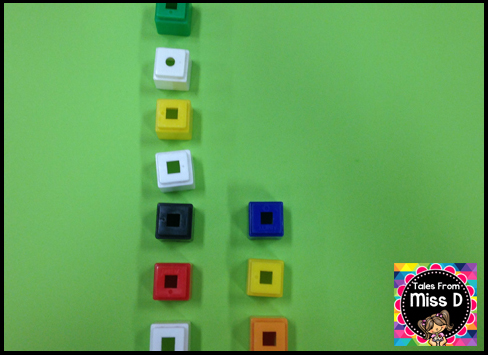
#1 - Get two groups of objects (can be counters, unfix cubes, etc).

#2 - Line up objects side by side, making sure the objects match/have a partner.

#3 - Look at where the matches stop and separate the objects that don't have a partner.

#4 - The objects that don't have a partner tell us 'how many more' are in the group.

When introducing the concept, stick to examples that don't have a huge difference i.e do 7 and 4 not 5 and 20. Keep it simple with small differences. Work on larger differences in the guided group part.

Of course, I want my students to be applying this independently while I am working with my small groups, so I made two centers that work on developing this skill.

Activity #1


In this activity, students pick a card and place that many counters/cubes on the top row. They pick another card and place that many counters/cubes on the bottom row. They then look at where the matching stops to determine 'how many more' and write the number at the bottom.

The grid is a great way for students to make sure the objects are lined up properly. If the objects are not lined up, then this strategy falls apart.

Activity #2
In this activity, students pick a card and make towers that correspond with the numbers. To find out how many more, students break the tower so that they become even. The amount broken off will reveal 'how many more'.


Students can then write the answer on the line.

Very simple, yet effective activities for students to develop this skill. You can find this product by clicking on the picture below :)

https://www.teacherspayteachers.com/Product/Comparing-Numbers-2191590


Enjoy the rest of your week!

Monday, 5 October 2015

New Term, New Centers!

Tomorrow will be the start of Term 4! For the non-Aussie teachers out there, that means the last 11 weeks of the school year. I can't believe how quickly the time has gone! Feels like just a few months ago it was the start of the year. Yikes!

Centers have been a big part of our daily routine this year. I'm always swapping them around to keep things interesting. Of course, now that it's nearing the end of the year, my kiddos are outgrowing the centers that I've been using. So I spent my holidays making some new centers that focus on the skills that we have been working on. Here are just a few that I'm excited to introduce this week;

Initial Sounds Detective - CVC Edition 

This activity requires students to look at the picture and work out the initial sound. They then write it in the box underneath the picture. The letters will spell out a CVC word. I love this activity because it's a great way to revise initial sounds and practise letter formation. Check it out here.

CVC - Race to Cover

This activity requires students to read a CVC word and see if they have a match on their board. This is a great way for students to practise sounding out. Check it out here.

CVC Clip It!

Students look at the picture, say the word and then clip the correct spelling with a peg. A great way to practise sounding out and develop fine motor skills! Check it out here.

Subtraction Math Centers


Three activities that require students to use subtraction to find the answer. Check it out here.

Domino Math Centers


Dominoes are a great way to incorporate key math skills in the classroom. These are just two out of the three domino activities in my Domino Math Centers pack.

The best part about all of these centers? they don't require too much cutting and there are no fiddly pieces! :)

Keep up to date with all my new products and sales by following my TPT Store, Twitter or Facebook page.

Happy teaching!

Tuesday, 6 January 2015

Robot Themed Alphabet & Number Centers

You know you're a teacher when you see something super cute and think "I can make a ______ activity out of that!".

I had that moment yesterday when I saw this robot jar!


Those "bang!" style games have always been quite popular in my room. What is a "bang!" game? it's where players take turns picking a card our of a container and say what's on their card. If they pull a "bang!" card, then they must put all their cards back. The game continues until all cards have been won.

As soon as I saw this jar, I knew this would be perfect for a "bang!" game :D

I'm on Kindergarten this year, so one of my big focus areas will be on letters, sounds and numbers.

Last night I created an alphabet & numbers pack to go with this jar. I know it's the holidays, but I am still very excited about having my own class again!


As you can see from the pictures, the pack covers;

* Lower case letters
* Uppercase letters
* Numerals
* Number names
* 10's frames

Simply select the cards you want your students to focus on!

The special card is called "Robot Dance". If a player draws this card, they must move their arms like a robot and then put all their cards back in the jar.

The cards also lend themselves to being used as a match game.


As the year goes on, I intend on making more cards to go in the jar. For now I am just sticking to the basics. If you would like your own copy, you can get it here at my TPT store by clicking on the picture below. The pack also includes mats that can be used for a Roll, Say & Keep style game. Don't you just love when one resource can be used in multiple ways?

http://www.teacherspayteachers.com/Product/Alphabet-and-Number-Centers-1633057

Hope you all have a wonderful week!

Stay tuned for more posts and sneak peaks of my latest resources :)