Showing posts with label discussion. Show all posts

Sunday, 4 January 2015

Comprehension - Part #5. Questioning

Questioning involves students asking and answering questions about a text. I'm not talking about basic questions like "what colour was the house?". I'm talking about deeper questions like "I wonder why the character....".

To get students familiar with asking the deep questions, introduce the thinking stem "I wonder". This automatically lends itself to deeper questioning as it requires students to come up with a question where the answer is not immediately obvious.

When introducing this strategy with my year one class, I used the wordless text, Window by Jeannie Baker. Any wordless text would do, but I love Jeannie Baker books as there is always so much going on in every picture.


As we looked through each page, I gave students a post-it note and asked them to write down their "I wonder..." questions. I got responses such as;

"I wonder why the birds are flying away from the park"

"I wonder why the boy is playing inside and not outside"

We then shared our questions with the class, and used these questions to start a discussion and hopefully find an answer to them. For the question about the birds, one student suggested that the birds were flying away because trees were being chopped down to make room for the houses. Pretty awesome for a year 1 class right?

By providing students with a thinking stem, I helped scaffold their learning, as opposed to just telling them to come up with a question about the text.

Once we had this down, we moved on to other thinking stems that promote deep questions, such as

What would happen if?

Why would...

These stems work best with a rich text, simply use the same procedure as introducing the "I wonder..." questions.

After the introductory lesson/s implement deep questioning as part of your guided reading groups. These questions also link really well with any scientific investigation!

You can even set up an "I wonder..." wall in the classroom that can be used throughout the year.

I have a bunch of Comprehension resources in my store that are very useful for implementing the strategies in your classroom :)

Next up, Summarising!

Sunday, 26 October 2014

Comprehension - Part #4. Making Connections

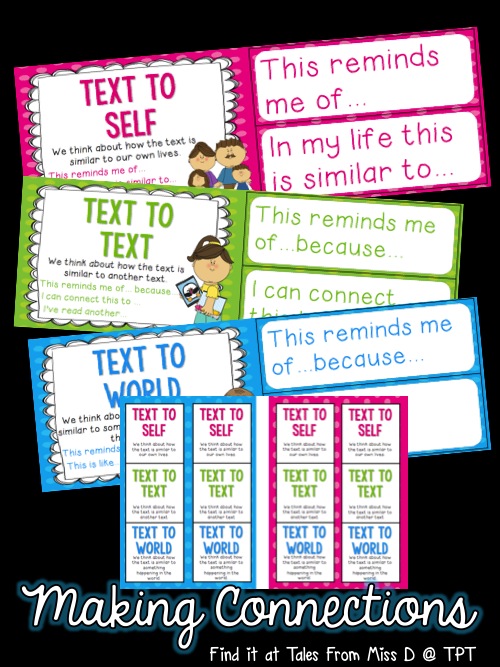
Making Connections is a great strategy to get students thinking about the text and how it is similar to themselves, another text or the world in which they live in. Making connections helps develop a deeper understanding of the text and the characters.

The easiest one to start with is Text-To-Self Connections.

To introduce this, I would pick a basic book that is about a situation that pretty much anyone can relate to. For the younger grades, any Charlie & Lola book is perfect. Before reading, tell students that you want them to listen to find a part of the book that is similar to their life. Read through the book and then have students talk with a partner about how they are similar to book/character.

Put up the prompt "This reminds me of..." on the board and have students use this to guide their answer for reporting back to the class.

In terms of bookwork, have students draw a picture and then write a sentence/paragraph about their connection. You can use the following sentence starters;

* This reminds me of...
* The character is like me because...
* I remember when...

Once students are comfortable with Text-To-Self connections, move onto Text-To-Text. Make the connection (ha!) between what they have just done and what they will be doing now (listening to connect). Good texts to use for this;

* The Gruffao and The Gruffalo's Child
* The Three Little Pigs and The True Story of the Three Little Pigs
*  The Stinky Cheeseman & Other Fairly Stupid Tales and any fairytale covered in the book
* Little Red Riding Hood and The Wolf's Story

Once again have students discuss and then write. This time use the sentence starters;

* The character _______ reminds me of ____________ in ________ because...
* The text ____________ reminds me of ___________ because...
* This story is like _______ because...

Teaching Text-To-Text connections provides a great starting block for comparing texts.

The last connection to teach is Text-To-World. Any text that is about a global issue would be fine. One of my favourites is George Saves the World by Lunchtime. This text is also great for reminding students about recycling and disposing of rubbish thoughtfully :D

Use these sentence starters to guide student responses;

* This reminds me of _________ because...
* This is like when....
* Something similar happened....

Once you have introduced these strategies, you can then use them as reading response activities. A great way to practice writing and encourage deeper thinking about what students have been reading!

I have a pack of posters and thinking stems in my TPT store that would be a perfect companion for teaching this strategy;
http://www.teacherspayteachers.com/Product/Super-Six-Comprehension-Strategies-Making-Connections-1432954

Next up: Questioning!

Wednesday, 24 September 2014

Comprehension - Part #3. Predicting.

Predicting is also an easy strategy to teach. Chances are, you are already doing it with your students, but the aim of this is to;

a) get your students to look closely at the clues in the text 
and 
b) get them to do it automatically, rather than have the teacher prompting all the time

To start off, define what predicting means. Explain that we predict before, during and after reading. Talk about what students can use to make a prediction; cover, titles, illustrations, blurb and text.

Pick a text and have students make a prediction. Give them the sentence starter "I predict". When they tell you their prediction, ask them why they think that. What clues from the text did they use? The sentence starter now becomes "I predict.....because.....".

You can use the above discussion for during reading predictions too.

As for after reading, the discussion turns to talking about what would happen if the author were to write a sequel. Students will use the events from the story to make this prediction. The sentence starter would be "I predict that......would happen next because.....". This can then turn into a writing task if you wish.

It is also important to confirm or reject predictions. That is, talking about whether they were right or wrong. Confirm or reject is just a more technical and nicer way of putting it. At this point, emphasise that it's totally okay if their predictions were rejected. Build up esteem by talking about how well they used the clues from the text :)

A neat way to set up this activity is to use three columns. My Prediction, What Happened and Confirm/Reject. The first two columns are pretty self explanatory, the confirm/reject can be completed with either a tick or a cross, or a C or a R.

If you want students to write about their predictions, here are some ideas;
1) Sentence starter "I predict" or "I predict....because..." Students can draw a picture to support their writing
2) Two columns. My Prediction and Clues From The Text
3) Have students predict what the characters will do, what the problem will be and how they will solve the problem.

My all time favourite activity is to stop reading just before the big ending. Have students write what they think will happen and draw a picture. Then read the ending and compare. It's one activity that the students absolutely love and it's pretty interesting seeing what they come out with.

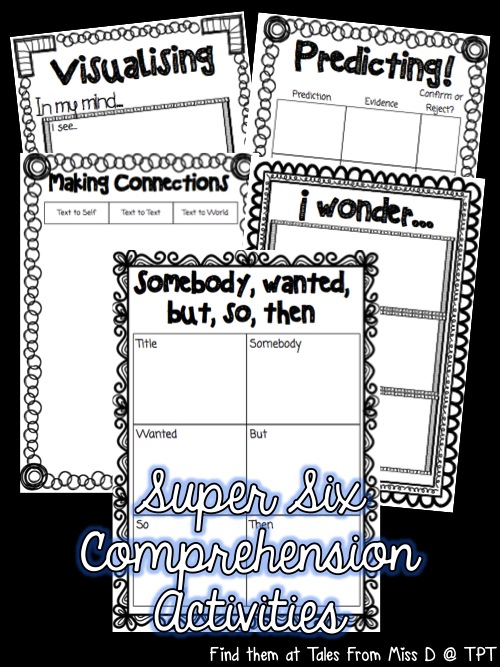
That's pretty much it for predicting. If you are looking for some graphic organisers they can be found in my Super Six Activity Pack;

http://www.teacherspayteachers.com/Product/Super-Six-Comprehension-Strategies-Activity-Pack-1259213

Next up in the series; Making Connections!

Saturday, 9 August 2014

A Week on Year 4

This week I was lucky enough to have one class for the entire week! I had a lot of fun. It's nice when you can plan a series of lessons that connect, rather than just turn up and do random, one off lessons.

So this post will be about my favourite lessons of the week, because if I write about everything, this will turn into a TLDR post.

For Literacy, I focused on The Gizmo by Paul Jennings.

I love his stories, I remember reading them as a kid and would spend hours reading them in one go. The Gizmo is a great story to do with the older grades as the story is interesting and has themes the students can relate to. If you haven't read this book before, it's about a boy called Stephen who is pressured into stealing by the school Bully, Floggit. Stephen feels guilty about stealing so he tries to make it right by returning what he stole. However he can't, so he tries to rid himself of the item in different ways. Along the way he faces a few entertaining mishaps and by the end of the story he has learned his lesson.

I had only read the first chapter, when the students started to ask and answer their own questions about the story (by themselves! I didn't even have to ask them to!). The main question; "Why would Stephen hang out with this Floggit guy when he is such a jerk?". So that started a big discussion on how sometimes people hang out with people they don't necessarily like because they don't want to be an outcast or seen as a loser.

Throughout the week we did a few activities around the book such as; coming up with excuses to tell Floggit to avoid stealing the Gizmo and character profiles. The character profile activity produced some great responses. I let the students design it however they wanted. So some of them did it as a wanted poster, some as a profile and one student drew a picture of Stephen and wrote paragraphs about his personality around the picture.

We finished the book on Thursday and I told the class that if they liked the story they could go to the library and check out other books by Paul Jennings. I also mentioned how he wrote a few other books about The Gizmo, so they begged me to bring them in for Friday.

On Friday I read The Gizmo Again.


Which, automatically lent itself to Text to Text Connections. Similar theme as the original; nice guy gets influenced by the bad guy to do the wrong thing and so he learns his lesson to not listen to the bad guy.

We also did some Reciprocal Teaching. I got to use my Reciprocal Teaching Pack (don't you just love shameless promotion?).


The text we used was Possum Magic by Mem Fox. To start off I went through each of the roles, the class was already familiar with this strategy, so it was a quick recap. Then as we read the text, students practiced using the roles. The text was good for the clarifying strategy, as it involved a lot of Australian terms and since some students were from different cultural backgrounds they didn't know what some of the things were. The internet was used to help with the visuals.

Another great Literacy lesson was about the book, A Little Election by Danny Katz.

After we discussed the story, I gave the students the task;
Imagine you want to be the 'Prime Minister of (insert school name here)'. What policies would you introduce and why? Develop a campaign to convince your teacher and peers to vote for you.

Students were allowed to work in groups or individually. They were allowed to develop their campaign however they wanted. Some students wrote a speech and some designed a poster. They used paper, computers and iPads to present their ideas.

I was pretty impressed, they came up with a lot of good ideas as well as justifying the reasons behind them. Was pleased to see that no one came up with the 'We will just play all day' idea :P

Our Art topic was 3D Illusion Art. Last week, I did the 3D hand activity and they were pretty impressed, so I did some research and found two more activities. On the Monday we did this one;

(Image credit; http://www.frubilledkunst.dk/)

On Tuesday, when I came back (on Monday, I had no idea that I would be back on that class for the rest of the week), a few of them had taken them home and completed them to show me. So, I knew that I had to find another one to do with them on my last day. We did this one;

(Image credit; http://www.teachkidsart.net/)
The thing I love about 3D Illusion Art is that it looks complicated, but it's actually quite simple and the kids just love it! It kind of makes me want to start up some kind of Art Club if I get a job next year...

I really enjoyed my week on the class. I've always seen myself as an Infants Only teacher, but I think I would quite enjoy having a year 4 class. I kind of wish I had put different preferences on my EOI for 2015. The kids kept asking me if I could be their teacher next year, lol. I wish!

Next week, I have work on Monday and then I am back to waiting eagerly by the phone. I seriously think I am the only nutter who is up at 5am each morning so I can be all ready to go if I get a call after 6am :P

In TPT news, I have uploaded a bunch of new products and revamped a few of my older ones. I'll write about them next time.

Enjoy what's left of your weekend :)

Tuesday, 24 June 2014

Casual Teaching on Year 5; Point of View and Persuasive Writing

Today I had a year 5 class. It's been a long, long, long time since I've taught one of the older grades. I spent 2011 and 2012 on Year 1 and in 2013 I did support on Kindy and Year 1.

I had a great day. I had planned my own work but the teacher had left me work. In the end I'm glad I had my own plans as there was a slight technical glitch and I had to fall back on my own work for part of the day until things were fixed. I'm just going to blog about the lesson I had planned which took up the whole morning session.

I got to use my latest resource which I specifically created for today; a Persuasive Writing Activity Pack. Click on the picture to check it out on TPT :)

http://www.teacherspayteachers.com/Product/Persuasive-Writing-Activity-Pack-1288271

We started off this morning with the story Dear Mrs. LaRue: Letters From Obedience School.


This was a great find a couple of year ago. I only paid $2 for it at a book store liquidation sale. For those not familiar with the story, it's about a dog called Ike who is sent to obedience school and writes letters to his owner. His letters are full of exaggeration and pleas for her to take him home. The illustrations are done in a clever way. There are two parts; b&w showing the exaggeration and the coloured ones showing how it really is.


The two types of illustrations provide a great discussion point about why the illustrator would do this and how it helps tell the story. From there, the discussion can easily lead into the topic; Point of View.

We completed a table comparing the point of view of Ike and what the pictures show.

After that students were given the task to write Mrs. LaRue a letter persuading her to come and take the dog home. Students could either be Ike or themselves.

Before sending them off to write, we talked about what a persuasive text was. Then we talked about the structure and what to include in each paragraph. We looked at an example text and looked at the features. Then students were giving a planning sheet to jot down their ideas before writing the letters.

Here are some of the pages that we used from the persuasive writing pack;


Reading their letters was entertaining. I was very impressed with their reasons for collecting Ike. They combined reasons from the story as well as their own ideas.

I would say that this lesson was a success. Students were able to talk about the different points of view presented and were able to write a decent persuasive letter.

The rest of the day was good. Did some place value and got to experiment with circuit boards and light bulbs. 

Thursday, 8 May 2014

Say Something! Comprehension Strategy

Today I am sharing a comprehension strategy I used and saw a lot of success with. It's called Say Something! Click on the picture to see the resource on TPT :)

http://www.teacherspayteachers.com/Product/Say-Something-Comprehension-Strategy-Pack-1236615

This strategy works by giving students a series of prompts to use when participating in discussions. The prompts help them to articulate their ideas.

I started off by introducing a few prompts each day. We used them in whole class discussions about texts and what we had been learning about. Students would use the prompts to share their ideas with a partner, in small groups and then to the whole class. Once they were confident in using them, I incorporated the prompts into my guided reading groups to have a discussion about the text.

I created a "Say Something! Superhero" display on my wall with the prompts so the students could refer to it. After a while, I noticed that the prompts were being used automatically in their responses, both orally and written. Students who were a bit shy in answering questions, started to respond more often as they had the prompts to help guide their response.

It was also pretty good to hear the students using more sophisticated language.

For older grades these prompts can be used to facilitate discussion during literature circles.

This resource can be printed full size or scaled down for individual student cards.